Guilt can be a positive emotion, but it's also often used as a tool to control or manipulate.


4 Min Read
Contents
Ah, the silent treatment in a relationship - nothing says, “I love you,” like being ignored.
No one likes the silent treatment, yet a lot of us use it. Many think,
Or, they simply don’t know how else to deal with conflict but to avoid it.
Unfortunately, most of us know what it feels like to get the silent treatment in our relationship, and we also know what it’s like to give it.
In couples counseling it's not uncommon for me to hear partners say,
He hasn't spoken to me in a week."
or
She ignored me for 3 days after our last fight."
But is it an effective way to handle conflict?
Or is giving the silent treatment ultimately detrimental to the health of your relationship?
Maybe even abusive?
Yes, the silent treatment in a relationship is a form of emotional abuse.
But let’s clarify - sometimes being quiet can be a good thing.
Using silence as a positive communication technique is okay too. Sometimes remaining silent so you can really listen to your partner, or to ensure your partner is able to fully express themselves can be hard to do, but also improves communication.
Practicing purposeful silence is different than the silent treatment and can be good for your relationship.
However, weaponizing silence and using it to punish your partner is a different matter.
What separates the silent treatment from being a good conflict management skill or communication tool is the intent behind using it and how long it lasts.
When it's used to hurt or punish, it’s really a form of passive-aggressive anger and harmful to your relationship.
And when the silence goes past a few hours, which should be long enough for all of us to cool down and get past the intensity of any hurt feelings, then it can becomea form of abusive behavior.
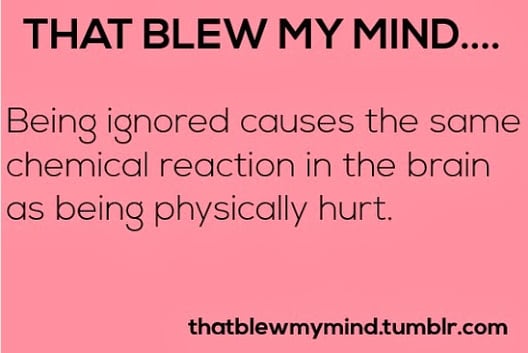
As the above social media post describes, getting the silent treatment in a relationship causes the same response in our brains as being physically hit.
Imaging shows that physical pain and social pain excite the same parts of our brain. The chemicals released in our bodies are the same too. Over time this kind of emotional abuse can even cause changes in the structure of our brains as well.
As if feeling shut out, unloved, and alone aren't enough, it also can cause us to question whether there’s something wrong with us. This can lead us to react in ways that are unhealthy and contrary to a healthy relationship.
When someone you love stops communicating with you, or ignores you outright for periods of time, it can create feelings of desperation.
You may find yourself,
The controlling and cruel nature of the silent treatment in relationships makes it a clear form of emotional abuse and relationship manipulation, creating an imbalance and unhealthy dynamic between partners.
The bottom line is the silent treatment isn't healthy because the strategy behind it is to withhold emotion and affection as a manner of punishment and for personal gain. It can be just as damaging as not controlling emotions at all or fighting all the time.
Changing your partner’s tendency (or yours) to use the silent treatment in your relationship will probably take some time. They may not even be aware of how damaging their behavior is.
To begin, you should try to understand why they gravitate towards using it in the first place.
People who use the silent treatment regularly were often subject to it themselves as children or witness to it in the relationships of important adult figures in their lives. In other words, they were taught that it's normal and okay.
Now, years later, using the silent treatment is what they know to do when they want to make a point, get their way, or are feeling hurt.
For others, the silent treatment may be a defense mechanism.
When these people become very upset or hurt they may completely shut down and refuse to communicate at all. The hope in doing this is that if there’s no more communication there will be no more pain. It’s a way of protecting themselves. Unfortunately, this strategy doesn’t work.
Making your partner aware of their behavior and its effect on you and your relationship, as well as the negative effects it has on them, is very important.
It may not be easy for them to stop what’s probably become a common response to conflict. So, consider working with your partner to build in some cooling off time during or after an argument.
This should be done with the agreement that you’ll always come back and discuss how you each feel and the topic of your conflict within a certain amount of time, say 24 hours.
However, be sure to put a limit on how long you can go without speaking to each other.
Making adjustments to the way you interact with one another, along with a pointed effort to stop using the silent treatment, is essential for the longevity of your relationship. Prolonged and cruel silence won’t lead anywhere positive.
Too many people accept the silent treatment in a relationship. Sometimes this acceptance is because they don't recognize it as abusive, but more often it’s because they feel powerless to change it.
Remember,
Being abused always includes a choice – and the right choice is to put a stop to it. We can't make someone talk to us, but we can choose whether we’ll accept being treated in that way.
Editor's Note: This post was originally published October 29, 2015, and updated on September 21, 2021, and has been updated again with new information for accuracy and comprehensiveness.
Guilt can be a positive emotion, but it's also often used as a tool to control or manipulate.
Guilt is a powerful emotion and not always a bad one. It can nudge us to do better, apologize when we’re wrong, and keep us from being deceptive. But when guilt is used as a tool to control or shame someone, or to maintain the upper hand in a relationship, it becomes dangerous and detrimental to emotional health.
Would you recognize Emotional Manipulation In Your Marriage? Check the signs of Emotional Manipulation In Marriage and how you can stop being manipulated.
© 2026 Guy Stuff Counseling & Coaching, APC, All Rights Reserved.
Privacy Policy | Sitemap | Do Not Sell or Share My Information
Featured logos are trademarks of their respective owners.
My boyfriend often gives me the silent treatment after fights, these can last anywhere up to 4 days.
Two days ago I met with him to get lunch in his work break.
When I sat down he insisted that something was wrong with me and that he could tell. He repeatedly kept asking what was wrong. I replied that nothing was, because honestly nothing was wrong and I was just happy to see him.
However he refused to let up and continued asking the same question over and over, even once id promised several times I was all good and happy and tried to change the topic.
I eventually just said there was things at home going on that I didn't want to talk about that might be showing stress on my face or something, but that I was honestly all good and happy.
He then started fiddling with his bottle and hands and refused to acknowledge my presence. After 10 mins of this I asked what was going on and if he was angry. He just said nothing was wrong. Several minutes later I tried again. He said that I didn't ell him what was wrong so why should he talk?. A few minutes later he accused me of not trusting him.
Then I got up to leave without saying a word. I went with him and asked if he would like me to leave. He just shrugged and said whatever so I Left.
We haven't spoken since. I am unsure how to proceed.
The silent treatment is not abuse if the “victim” (lol, please) doesn’t care or isn’t affected by it. My husband said some hurtful, hateful things to me 3 days ago, and I stopped interacting with him altogether. I sleep in the guest room now, and he doesn’t care. In fact, he’s oblivious. He’s made no attempt at apology. He hasn’t even asked me why I moved to the other room. I can’t hope to reconcile or “work it out,” because according to him, my “point of view doesn’t mean sh*t.” Why in the world would I try to talk to someone that believes that??